
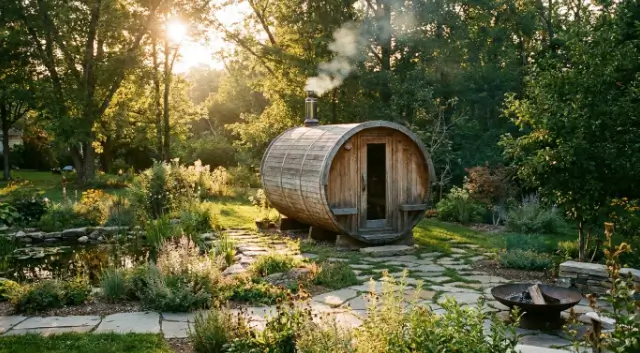
A barrel sauna worth buying comes down to five things: stave thickness of at least 1.5 inches, a stable cradle or skid base rated for the barrel’s diameter, a wood species suited to outdoor exposure, a heater sized correctly for the cubic footage inside the curve, and a roof pitch steep enough to shed rain and snow without pooling. Diameter typically ranges from 6 to 8 feet, and that single measurement drives seating capacity, heater size, and price more than any other spec on the listing.
Why Curved Construction Changes What to Check
A barrel sauna is not just a rectangular cabin bent into a circle. The curved staves that form the walls rely on tension bands, called hoops, to hold the shape, and those bands need to be checked periodically and re-tightened as the wood settles over its first year or two outdoors. The curve itself has a real functional benefit: rain and snow run off the rounded roof line naturally instead of pooling the way they can on a flat cabin roof, which is one reason barrel saunas hold up well in wet climates without needing a membrane roof system.
Look closely at how the staves meet at the ends. Quality construction uses a tongue-and-groove or dowel-pinned joint between each stave, with no exposed metal fasteners on the interior. Cheaper units sometimes rely on visible screws through the stave face, which heat up fast and can be uncomfortable to lean against once the cabin reaches temperature.
Diameter Drives Almost Everything Else
Barrel saunas are sold by diameter, most commonly 6, 7, or 8 feet, and that number determines interior volume, bench configuration, and how many people fit comfortably. A 6-foot diameter is a realistic two- to three-person size with a single bench run along one curved wall. Stepping up to 7 or 8 feet adds either a second bench tier or more legroom on the lower bench, and typically accommodates four to five people. Length matters too, usually 6 to 9 feet, since a longer barrel adds bench space without increasing diameter, which is often the more affordable way to add capacity.
Get the diameter measurement before ordering a heater or planning the site. A heater sized for a 6-foot barrel will underperform in an 8-foot one, and a foundation pad cut for the wrong diameter means redoing groundwork before the barrel even arrives.
What Does the Cradle and Base Actually Need to Support?
Most barrel saunas rest on a cradle, a curved skid base that keeps the barrel off the ground and allows a small amount of airflow underneath, which helps the bottom staves dry out between uses. That cradle sits on a foundation that does not need to be a poured concrete slab. A level gravel pad, a paver base, or an existing deck rated for the load are all common and acceptable, as long as the surface is flat and drains well. Standing water under the cradle is the single fastest way to rot the bottom staves prematurely, so site grading matters more for a barrel sauna than for most other outdoor structures of similar size.
Which Wood Actually Performs Outdoors
Two species dominate the barrel sauna market for good reason. Western red cedar resists rot and insects naturally, needs minimal maintenance beyond an occasional exterior oil treatment, and ages to a silvery gray if left untreated, which some owners prefer visually. Thermally modified aspen or spruce is heat-treated rather than chemically treated to resist moisture absorption, and it typically costs less than cedar while offering comparable outdoor durability. Both are reasonable choices; the decision usually comes down to budget and whether the natural cedar look and scent matter to the buyer.
Avoid listings that describe the wood only as “premium” or “select grade” without naming the species. A legitimate barrel sauna maker states the wood species, the stave thickness, and whether the wood has been kiln-dried or thermally modified, since all three affect how the barrel performs outdoors over several winters.
What Does the Health Research Actually Support?
Marketing around sauna purchases often leans on health claims, and it is worth knowing what the research actually says before that factors into a buying decision. A review in Mayo Clinic Proceedings on the cardiovascular and other health associations of sauna bathing describes lower rates of cardiovascular events among frequent users in Finnish cohort studies, four to seven sessions a week in the strongest associations. A systematic review of regular dry sauna bathing in Evidence-Based Complementary and Alternative Medicine reports similar patterns across multiple studies. An older review in The American Journal of Medicine on the benefits and risks of sauna bathing takes a more measured tone and is a useful reminder that this is population-level association, not a guarantee for any one household.
None of this research is specific to barrel-style saunas as opposed to other traditional dry sauna formats, and it should not be read as proof of any individual health outcome. It is a reasonable starting point for understanding why frequent, sustained use shows up consistently in the studies that back the wellness claims made about home saunas generally.
Comparing Sellers Before You Commit
Once diameter, wood species, and heater size are settled, the remaining decision is who to buy from. Specialty outdoor sauna retailers including SweatDecks list model-by-model specs, including stave thickness and cradle dimensions, side by side, which makes it easier to compare barrels at a similar price point without guessing at details a generic listing leaves out. Cross-check any listing that skips stave thickness or wood species entirely, since that omission is one of the more reliable signs of a lower-quality import barrel priced to look competitive on diameter alone.
Frequently Asked Questions
What diameter barrel sauna fits two to three people? A 6-foot diameter comfortably seats two to three people on a single bench run. A 7 to 8-foot diameter adds a second bench tier and typically fits four to five people.
How thick should barrel sauna staves be? Most quality barrels use staves between 1.5 and 2 inches thick. Thinner staves heat faster but hold less heat, while thicker staves take longer to warm but retain temperature better.
Does a barrel sauna need a foundation? Most sit on a cradle and need a level gravel pad, paver base, or existing deck rather than poured concrete. The key requirement is a flat, well-draining surface.
What wood species holds up best outdoors? Western red cedar and thermally modified aspen are the two most common choices. Cedar resists rot naturally; thermally modified wood is often more affordable with comparable durability.
References
- Cardiovascular and Other Health Benefits of Sauna Bathing: A Review of the Evidence, Mayo Clinic Proceedings, 2018
- Benefits and risks of sauna bathing, The American Journal of Medicine, 2001
- Clinical Effects of Regular Dry Sauna Bathing: A Systematic Review, Evidence-Based Complementary and Alternative Medicine, 2018
By Dale Whitfield
